Anyone can smoke a cigar. Learning how to study the experience requires more attention.
Tasting a cigar is not about inventing the longest list of flavors or repeating descriptions written by someone else. It is about observing what the cigar actually delivers to your palate.
How does it draw? Does it burn evenly? Does the flavor remain balanced? Does the cigar change as it progresses? Would you want to smoke it again?
The Ashology™ approach examines the complete experience — from appearance and construction to flavor, balance, complexity, consistency and finish.
This guide explains how to taste a cigar, identify flavor impressions and record an independent evaluation before comparing your judgment with the Ashologist.
How Do You Taste a Cigar?
Prepare your palate and smoking environment.
Examine the cigar before cutting it.
Smell the wrapper and open foot.
Take a cold draw before lighting.
Light the cigar evenly and smoke slowly without inhaling.
Observe the first, second and final thirds.
Separate flavor, strength and body.
Evaluate construction, balance and development.
Record your score before reading anyone else’s opinion.
The goal is not to identify a predetermined answer. The goal is to document your own experience honestly.
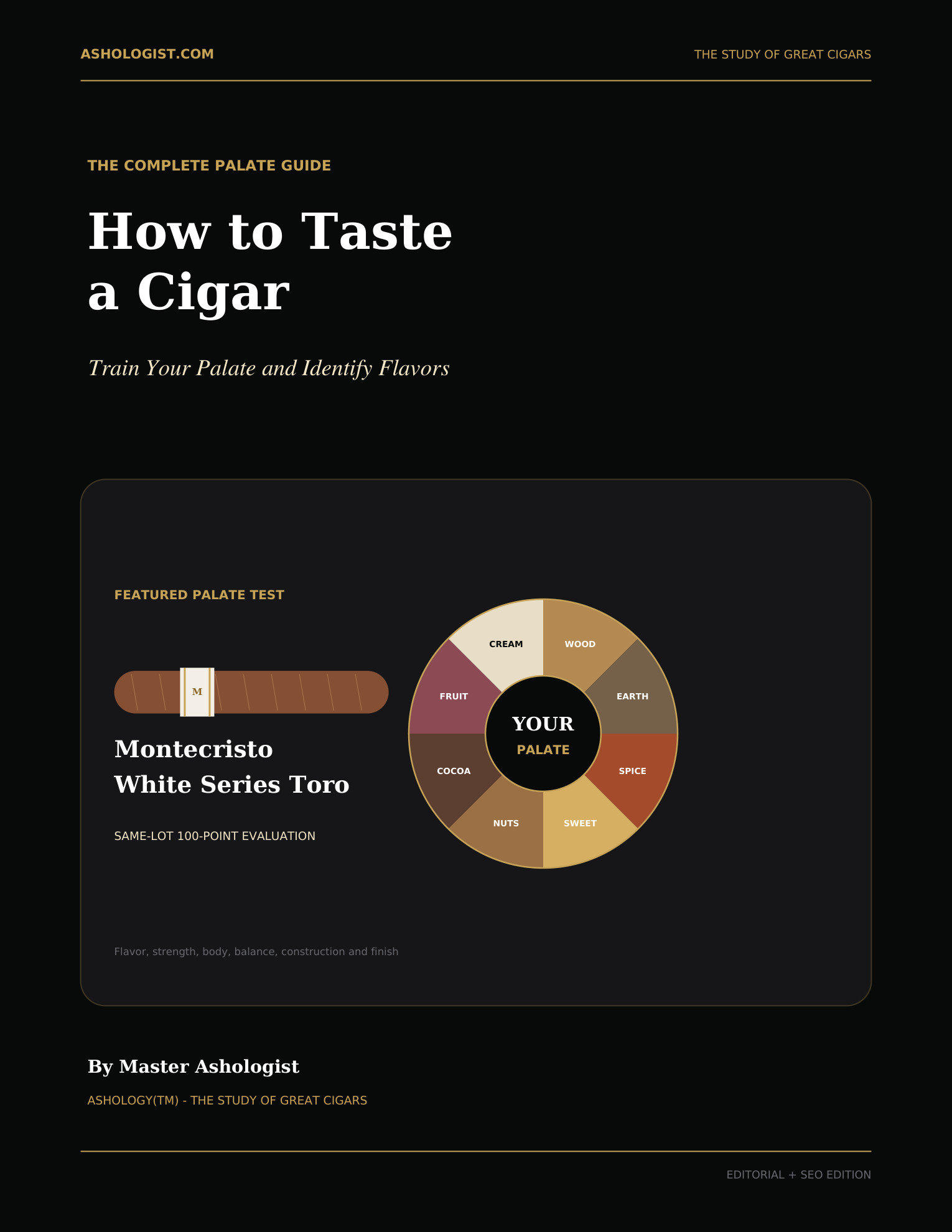
Featured Ashology™ Palate Test
Montecristo White Series Toro
The featured Ashology™ palate test uses the Montecristo White Series Toro, a 6 × 54 cigar produced in the Dominican Republic.
Montecristo White Series Toro — published profile
Attribute
Montecristo White Series Toro
Vitola and size
Toro — 6 × 54
Origin
Dominican Republic
Factory
Tabacalera de Garcia, La Romana
Wrapper
Ecuadorian Connecticut Shade
Binder
Nicaraguan
Filler
Dominican and Nicaraguan
Published strength
Mild to Medium
Published body
Medium
These details identify the cigar, but they do not tell you what score to give it. The official Ashologist score and flavor comparison remain hidden until you complete and submit your own evaluation.
Featured same-lot evaluation
Montecristo White Series Toro
Smoke the cigar, record your independent 100-point evaluation, then compare your judgment with the Ashologist. Official scores and flavor notes stay hidden until you submit.
Two experienced smokers can evaluate the same cigar and identify different flavor impressions. One may notice cedar where another experiences toasted wood. One may describe sweetness as honey, while another interprets it as cream or mild caramel.
Neither person must be wrong.
Your perception can be affected by:
Previous foods and drinks, hydration and time of day
Smoking pace, temperature and humidity
Personal flavor memories and experience with similar cigars
The condition and storage of the cigar
Expectations created by the brand or price
The purpose of Test Your Palate is not to copy the Ashologist’s answer. It is to discover where your observations agree, where they differ and how your judgment develops over time.
Step 1: Prepare Your Palate
Strong food, spicy meals, sugary drinks, alcohol, coffee and mouthwash can remain on the palate and influence the cigar.
Drink water and allow your palate to settle after a meal.
Avoid heavily flavored food, toothpaste or mouthwash immediately beforehand.
Choose a comfortable environment without distracting odors.
Give yourself enough time to finish without rushing.
Room-temperature water is an excellent palate cleanser because it refreshes the mouth without adding competing flavors. Coffee and spirits can complement a cigar, but water provides the most neutral starting point for evaluation.
Step 2: Remove Outside Influence
A band, brand name, price or reputation can create expectations before the cigar is lit.
Do not read reviews or look for the official score before smoking.
Do not ask another participant what they tasted.
Do not decide your score based on the brand’s reputation.
Do not assume mild strength means limited flavor.
Do not change your notes merely to agree with someone else.
Judge the cigar in front of you — not the reputation surrounding it.
Step 3: Examine the Cigar
Tasting begins before lighting. Look at the wrapper, cap, foot and overall construction.
Is the wrapper evenly applied and the color consistent?
Are there visible cracks, tears, unusually hard or soft areas?
Is the cap applied cleanly and the foot evenly packed?
Does the cigar feel excessively dry or moist?
Appearance cannot determine the complete score, but it establishes the first impression and may reveal construction or storage issues. Appearance and Presentation is worth five points in the Ashology™ 100-point palate test.
Step 4: Smell the Wrapper and Foot
Before cutting, smell the wrapper and open foot separately. The wrapper aroma may be subtle; the foot exposes filler tobaccos and may provide a stronger aroma.
General pre-light impressions can include fresh tobacco, cedar, hay, earth, cocoa, pepper, leather, sweetness, dried fruit, nuts or natural agricultural aromas.
Do not force yourself to identify something. “Clean tobacco aroma” is valid. So is “very little aroma.”
Step 5: Take the Cold Draw
Cut the cigar carefully and take one or two gentle draws before lighting. First evaluate whether the airflow is too open, comfortable, slightly resistant, too tight or nearly plugged.
Next, notice whether the unlit tobacco creates flavor impressions. Those impressions may disappear, remain or change after lighting. Record them without deciding that the lit cigar must follow the same direction.
Step 6: Light the Cigar Evenly
Toast the complete foot while rotating the cigar. Once the outer edge begins to glow, continue rotating while taking several gentle draws. Check the foot afterward; the complete surface should be burning evenly.
If only the center is lit, the cigar may develop early burn problems. If the tobacco is scorched with excessive flame, the opening flavors may become harsh.
A cigar smoked too quickly will usually become hot. Excessive heat can create bitterness, harshness, burn problems, reduced sweetness and limited flavor clarity.
A useful starting rhythm is approximately one gentle puff every 30 to 60 seconds. Draw the smoke into your mouth, allow it to move across the palate and then exhale. Cigar smoke should not be inhaled into the lungs.
Let the cigar rest between draws. You are trying to taste the tobacco — not race through it.
Step 8: Divide the Experience Into Thirds
Many cigars change from beginning to end. Dividing the experience into thirds makes those changes easier to observe.
First Third
The first third introduces the cigar. Opening pepper or combustion intensity may settle after several puffs. Record the opening flavor, draw, smoke production, burn establishment, strength, body and early balance.
Second Third
The second third often provides the clearest expression of the blend. Ask whether flavor became clearer, sweetness or spice changed, the smoke texture shifted, strength increased or new flavors appeared.
Final Third
The final third is usually warmer and more concentrated. Consider whether the cigar remained balanced, became richer or simply hotter, required more corrections and completed the experience successfully.
Strength, Body and Flavor Are Different
Strength
Strength describes nicotine intensity and physical impact.
Body
Body describes the weight, richness and texture of the smoke on the palate.
Flavor
Flavor describes the individual impressions experienced while smoking.
A cigar can be mild in strength while delivering substantial flavor. It can also be powerful without offering great flavor clarity or complexity. Do not increase a flavor score simply because a cigar feels strong.
Common Cigar Flavor Categories
Flavor descriptions communicate impressions. Natural tobacco can create associations with familiar aromas and tastes.
You do not need to identify several categories in every cigar. A clear impression of cedar, cream and pepper may be more meaningful than an uncertain list of twelve flavors.
What If You Cannot Identify Any Flavors?
This is normal, especially for a new smoker. Begin with broad questions:
Is the flavor sweet, dry or neutral?
Is it creamy or sharp, earthy, woody or spicy?
Is the smoke light or heavy?
Is the finish short or long?
Is the experience smooth or aggressive?
Are the flavors clear or difficult to separate?
Become more specific as your palate develops. Clarity is more valuable than performance.
How to Use Retrohaling
Retrohaling means directing a small amount of smoke through the nasal passage without inhaling it into the lungs. The nose can identify aromas that may not be obvious on the palate.
It is optional and should be approached carefully. Use only a small amount of smoke; strong tobacco can create an uncomfortable sensation in the nose.
Construction Is Part of Taste
Flavor does not exist separately from performance. A severely restricted draw may produce less smoke and hide flavor. An uneven burn may change the tobacco proportions being consumed. Excessive relighting can introduce bitterness.
Evaluate draw resistance, burn consistency and smoke production.
Observe combustion, wrapper integrity and ash formation.
Record the need for corrections and the ability to remain lit.
A minor touch-up does not automatically ruin a cigar. Repeated corrections, a plugged draw or serious structural problems should influence the construction score.
What Does Balance Mean?
Balance describes how flavor, strength, body, smoke texture, sweetness, spice and finish work together.
A cigar can be complex without being balanced, and balanced without frequent changes. A balanced cigar feels composed; no single characteristic unintentionally destroys the complete experience.
What Are Complexity and Development?
Complexity describes depth, layering and range. Development describes how the experience changes over time.
Change alone is not automatically better. The changes must contribute something meaningful and enjoyable. Ask whether the cigar revealed layers, transitioned naturally, remained interesting and completed the final third successfully.
Record Your Notes Before Seeing the Official Score
Write observations while smoking. Record pre-light appearance, cold-draw impressions, each third, construction, strength, body, balance, finish, overall impression and whether you would smoke it again.
Complete your score before looking for outside validation. The value comes from completing your judgment first.
The Ashology™ 100-Point Palate Test
Test Your Palate uses eight categories totaling 100 points.
Official Ashology™ 100-point scorecard
Evaluation category
What to evaluate
Maximum points
Appearance and Presentation
Wrapper appearance, color and consistency, visible construction, firmness, overall presentation
5
Construction
Cigar structure, wrapper application, cap construction, resistance to cracking, ash formation, overall craftsmanship
15
Draw and Burn
Draw resistance, burn consistency, need for corrections, smoke production, combustion performance
10
Flavor Quality
Flavor quality, flavor clarity, richness, enjoyment, distinctiveness, quality of the tobacco character
Flavor transitions, development throughout the cigar, depth, layering, changes between smoking sections, ability to remain interesting
15
Consistency
Flavor consistency, burn consistency, draw consistency, construction consistency, overall performance from beginning to end
10
Finish and Overall Experience
Finish, aftertaste, satisfaction, memorability, overall impression, desire to smoke the cigar again
10
Total possible score
Eight categories used exclusively for Test Your Palate Against the Ashologist
100
The 100-point system is used exclusively for Test Your Palate Against the Ashologist. It remains separate from formal Ashology™ market evaluations and the 30-point system used by the CigarOfTheYear.com tournament. The two systems are not converted into one another.
Two cigars carrying the same name can still perform differently. Storage, production variation, age and handling may affect the experience.
Whenever possible, the cigar evaluated by the Ashologist and those distributed to participants are selected from the same master case or production lot. This reduces avoidable differences and makes comparison more meaningful.
The Montecristo White Series Toro Challenge
The Montecristo White Series Toro gives participants a practical way to apply everything explained in this guide.
Smoke the cigar from the Ashology™ test pack.
Complete either the Quick or Complete Evaluation.
Select the flavors you personally experienced.
Record optional notes for each third.
Review and submit your final score.
Reveal the official Ashologist score.
Compare categories and flavor matches.
Save, receive or share your result.
The official evaluation remains hidden until submission is complete. That protects your first impression from outside influence.
Think your palate is ready?
Complete your independent evaluation first. The official Ashologist score is revealed only after you submit.
Begin with broad observations such as sweet, dry, woody, earthy, spicy, creamy or strong. More specific recognition develops through repetition and note-taking.
Is there a correct list of cigar flavors?
No. Published tasting notes describe another person’s perception. Your experience may agree or differ.
What is the difference between flavor and strength?
Flavor describes what you taste and smell. Strength describes nicotine intensity and physical impact.
What does body mean in a cigar?
Body describes the weight, richness and texture of the smoke on your palate.
Do you need to retrohale to taste a cigar?
No. Retrohaling may reveal additional aromas, but it is optional.
What should you drink during a palate test?
Water is the most neutral choice because it cleanses the palate without adding strong competing flavors.
Why does the same cigar sometimes taste different?
Storage, production variation, smoking pace, environment, food, drink and personal condition can all influence the experience.
Is my evaluation wrong if it does not match the Ashologist?
No. The comparison shows where observations agree and differ. It is not a pass-or-fail examination.
When is the official Ashologist score revealed?
The official score remains hidden until you complete and submit your evaluation.
Can I change my score after seeing the Ashologist result?
No. A submitted score is locked so the comparison reflects independent judgment.
The Final Answer
Learning how to taste a cigar is not about finding impressive words. It is about becoming more observant.
Prepare your palate. Smoke slowly. Follow the cigar from beginning to end. Separate flavor from strength. Pay attention to construction, balance, development and consistency.
Most importantly, record your judgment before allowing brand reputation, price or another person’s review to influence it.
Your palate does not need to copy the Ashologist. It needs to become more aware of what it experiences.