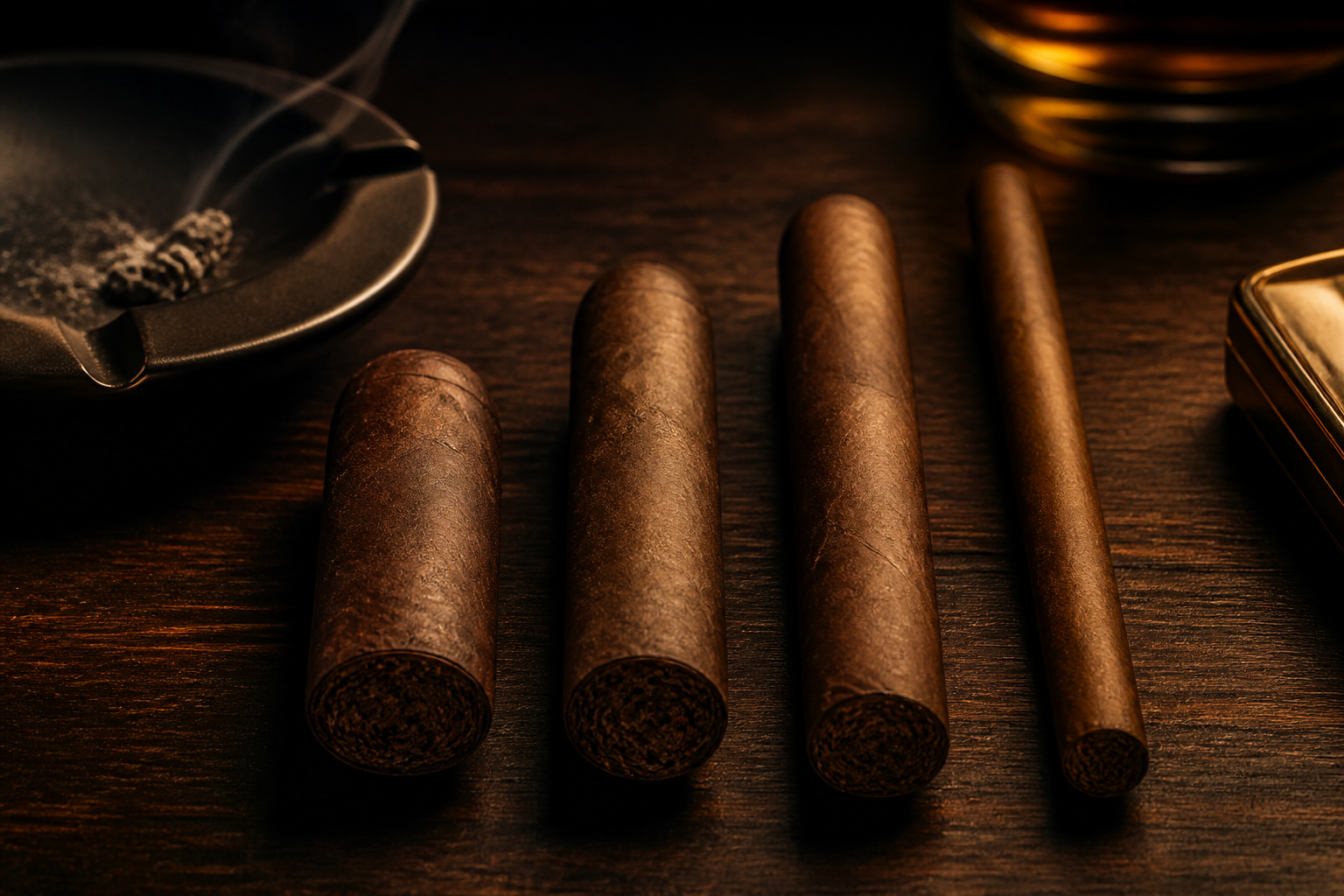
Choosing a cigar can become confusing before you ever consider its wrapper, strength or flavor. What is the difference between a Robusto and a Toro? What does a 52 ring gauge mean? Does a larger cigar taste stronger? How much time should you set aside for a Churchill?
Cigar size affects more than appearance. It can influence smoking time, burn temperature, tobacco proportions and how a blend develops from beginning to end.
This complete cigar-size guide explains the most common shapes, lengths, ring gauges and approximate smoking times so you can choose the right cigar for your taste, schedule and experience level.
The Quick Answer
A Robusto offers a concentrated 40-to-60-minute experience. A Toro provides about 60 to 90 minutes and more room for development. A Churchill usually requires 75 minutes to two hours. The blend — not the size — remains the primary factor determining strength and flavor.
Complete Cigar Size Chart
The measurements below represent typical industry ranges rather than strict rules. One manufacturer’s Toro may be slightly longer or thicker than another manufacturer’s Toro.
Smoking times are approximate. Your pace, the cigar’s moisture level, tobacco density, construction and surrounding conditions can all affect how long it burns.
What Does Cigar Ring Gauge Mean?
Ring gauge measures the diameter of a cigar in sixty-fourths of an inch.
- A 40 ring gauge measures 40/64 of an inch in diameter.
- A 50 ring gauge measures 50/64 of an inch.
- A 60 ring gauge measures 60/64 of an inch.
A 50-ring-gauge cigar is therefore a little more than three-quarters of an inch thick.
When a cigar is listed as 6 x 52, the first number represents its length in inches and the second represents its ring gauge. That cigar is six inches long and 52/64 of an inch in diameter.
Does Ring Gauge Affect Flavor?
Yes, but not in the simple way many smokers assume.
A cigar is constructed from three major tobacco components: the wrapper, the binder and the filler tobaccos. In a thinner cigar, the wrapper represents a greater proportion of the tobacco encountered with each puff. That can make the wrapper’s character more noticeable.
A larger ring gauge gives the blender more physical room to combine different filler leaves. This can create greater filler complexity, a cooler burn and a different balance between wrapper and filler.
Neither approach is automatically better. The same blend may express itself quite differently in a Lancero, Robusto, Toro or Gordo.
Does a Larger Cigar Mean a Stronger Cigar?
No. Size does not automatically determine strength.
Cigar strength is influenced primarily by the tobacco varieties used, their growing regions, the amount and placement of ligero, fermentation and aging, and the balance of the complete blend.
A large Gordo can be mild. A thin Lancero can be powerful. A bigger cigar may feel smoother because it burns cooler, but that does not necessarily mean it contains less nicotine.
When choosing strength, examine the blend and the manufacturer’s stated intensity rather than relying on size alone.
Parejo vs. Figurado: The Two Main Cigar Shapes
Most cigar formats fall into one of two broad shape families.
Parejo Cigars
A parejo has straight sides, an open foot and a capped head. Common parejos include the Corona, Robusto, Toro, Churchill, Gordo, Lancero, Lonsdale and Double Corona.
Figurado Cigars
A figurado departs from the traditional straight-sided shape. One or both ends may taper, and the body may widen or curve. Examples include the Torpedo, Belicoso, Pyramid, Perfecto and Salomon.
Figurados can be visually dramatic, but their real significance lies in construction. Their changing diameter can alter airflow, burn behavior and flavor concentration as the cigar progresses.
The Padrón 60th Anniversary Perfecto, the official 2026 Cigar of the Year, demonstrated how a distinctive shape and exceptional construction can work together at the highest level. Explore the championship on CigarOfTheYear.com.
Robusto Cigars
A Robusto typically measures about five inches long with a ring gauge between 48 and 52. It is one of the most popular modern cigar sizes.
Why Smokers Choose the Robusto
- It can usually be enjoyed in less than one hour.
- Its shorter length brings the blend into focus quickly.
- Its ring gauge feels substantial without becoming oversized.
- It is widely available across premium cigar lines.
- It provides enough filler space for complexity while remaining manageable.
Who Should Choose a Robusto?
The Robusto is an excellent starting point for a new smoker and a dependable everyday format for an experienced smoker. It fits after-dinner sessions, cooler weather, shorter lounge visits or any occasion when you want a complete experience without committing 90 minutes.
Toro Cigars
A Toro commonly measures around six inches long with a ring gauge from 50 to 54.
Why Smokers Choose the Toro
- It offers a balanced combination of length and thickness.
- It generally provides 60 to 90 minutes of smoking time.
- The blend has more room to develop gradually than in a Robusto.
- It is widely available and often treated as a core size.
- Its ring gauge permits meaningful filler complexity.
Who Should Choose a Toro?
Choose a Toro when you have about an hour to an hour and a half and want to observe how a blend changes through its first, second and final thirds. It is one of the most versatile sizes and often the best first experience with an unfamiliar cigar line.
Churchill Cigars
A Churchill traditionally measures around seven inches long with a ring gauge near 47 to 50.
Why Smokers Choose the Churchill
- It creates a long, deliberate smoking session.
- Its length allows gradual transitions to unfold.
- Its classic proportions are elegant and recognizable.
- It can deliver a cooler experience when smoked patiently.
- It suits occasions when time is not a concern.
Who Should Choose a Churchill?
Choose a Churchill when you can devote 75 minutes to two hours to the cigar. It is well suited to long evenings, lounge sessions and occasions when the smoking experience itself is the event.
Do not select a Churchill if you know you will need to rush. Smoking too quickly can overheat the tobacco and turn a potentially refined cigar harsh.
Robusto vs. Toro vs. Churchill
If you are uncertain, begin with a Robusto or Toro. Choose the Robusto when time is limited, the Toro when you want more development and the Churchill when you want the cigar to become the centerpiece of a long session.
Corona Cigars
The Corona is one of the classic reference sizes in the cigar world. It usually measures approximately 5.5 to 6 inches with a ring gauge between 42 and 46.
Its slimmer profile gives the wrapper a more prominent role than in many larger-ring cigars. This often creates a focused, traditional smoking experience.
Choose a Corona when you want classic proportions, clear wrapper influence and a manageable 35-to-60-minute smoke.
Gordo Cigars
A Gordo generally measures around six inches with a ring gauge of 58, 60 or greater.
The large diameter allows a blender to incorporate a broad combination of filler tobaccos. It can also create a cooler burn when smoked patiently.
However, more tobacco does not automatically mean more complexity. The blend must still be constructed with purpose.
Choose a Gordo when you prefer a substantial feel, cooler smoke, longer duration and a filler-driven experience.
Lancero Cigars
A Lancero is long and slender, usually around seven inches with a ring gauge between 36 and 40.
Because the wrapper represents a larger proportion of the cigar, the Lancero can showcase wrapper character with exceptional clarity. It also requires careful rolling and a slow smoking pace.
A poorly constructed Lancero may develop draw or burn problems more easily than a larger cigar. A well-made Lancero can be precise, elegant and highly expressive.
Choose a Lancero when you are comfortable smoking slowly and want to study how the wrapper shapes the blend.
Torpedo Cigars
A Torpedo has a tapered, pointed head. Its body is generally straight or gradually shaped, while its foot is usually open.
The tapered head allows the smoker to control the opening by cutting conservatively. A smaller cut may concentrate the smoke, while a slightly larger cut can increase airflow.
Begin with a shallow cut. You can always remove more, but you cannot restore the cap after cutting too deeply.
A Torpedo should still draw comfortably. Its shape is not an excuse for restricted airflow.
Perfecto Cigars
A Perfecto generally tapers at both ends and widens through the middle. Its dimensions can vary considerably.
The changing diameter can create a naturally evolving experience. The initial puffs may be more concentrated at the tapered foot before the burn reaches the wider body and engages more filler tobacco.
Perfectos are demanding to roll well. Proper construction should allow the cigar to light evenly, open naturally and maintain a dependable draw as the diameter changes.
Choose a Perfecto when you appreciate craftsmanship, visual distinction and the way a changing shape can influence flavor progression.
How Cigar Length Affects Smoking Time
Length is one of the main indicators of smoking time, but it is not the only one.
- Ring gauge and total tobacco volume
- How tightly the cigar is rolled
- The tobacco’s moisture level
- Construction and airflow
- Your smoking pace
- Wind, temperature and outdoor conditions
- How frequently you draw on the cigar
Treat published smoking times as planning estimates rather than guarantees.
How to Choose a Cigar Size Based on Time
The best cigar size is the one you can finish comfortably without rushing.
If You Have About 30 Minutes
- Petit Corona
- Short Corona
- Small-format cigar
If You Have 45 to 60 Minutes
- Robusto
- Corona
- Short Toro
If You Have 60 to 90 Minutes
- Toro
- Lancero
- Lonsdale
- Torpedo
- Smaller Perfecto
If You Have More Than 90 Minutes
- Churchill
- Gordo
- Double Corona
- Large Perfecto or Salomon
What Is the Best Cigar Size for Beginners?
A Robusto is often the best starting size because it is comfortable to hold, widely available and usually lasts less than one hour.
A Toro is also an excellent choice when the smoker has more time and wants to experience gradual flavor development.
The blend’s strength matters more than the cigar’s dimensions. New smokers should generally look for a mild-to-medium blend with dependable construction, a comfortable draw, a manageable smoking time and flavor that does not become aggressive.
For additional guidance, read Best Mild Cigars for Beginners on CigarOfTheYear.com.
Does the Same Cigar Taste Different in Another Size?
It can. Even when a manufacturer uses the same blend name across several vitolas, the proportions may create a noticeably different experience.
- The wrapper-to-filler ratio changes.
- The combustion temperature may change.
- Airflow and smoke concentration may differ.
- The blend may develop more quickly or gradually.
- Certain flavor stages may last longer in one size than another.
A Robusto may feel direct and concentrated. A Toro may unfold more gradually. A Lancero may emphasize the wrapper. A Gordo may highlight filler complexity.
This is why trying the same cigar in several sizes can be one of the most educational exercises available to a developing smoker.
Common Cigar Size Mistakes
Assuming a Larger Cigar Is Stronger
Strength comes from the tobacco and blend, not the size alone.
Choosing a Cigar That Requires Too Much Time
A great Churchill becomes a poor choice if you only have 45 minutes.
Smoking a Large Cigar Too Quickly
A rapid pace can overheat the cigar and create harshness.
Cutting a Figurado Too Deeply
Begin with a conservative cut and increase the opening only when necessary.
Treating Size Names as Exact Measurements
Always review the listed length and ring gauge. Names vary among manufacturers.
Buying by Appearance Alone
A dramatic shape can be appealing, but construction, blend and appropriate smoking time remain more important.
Frequently Asked Questions
What does 6 x 52 mean on a cigar?
It means the cigar is six inches long with a ring gauge of 52/64 of an inch.
What cigar size lasts about one hour?
A Robusto often lasts 40 to 60 minutes, while a Toro usually lasts 60 to 90 minutes. Your pace and the cigar’s construction will affect the actual time.
What is the difference between a Robusto and a Toro?
A Toro is usually about one inch longer and may be slightly thicker. It generally provides more smoking time and slower flavor development.
What is the difference between a Toro and a Churchill?
A Churchill is longer and sometimes slightly thinner. It usually requires more time and develops more gradually.
Is a 60-ring-gauge cigar stronger than a 50-ring-gauge cigar?
Not necessarily. Strength depends on the tobacco blend rather than diameter alone.
What cigar size is best for a beginner?
A Robusto is often the easiest starting point, though blend strength matters more than size.
Which cigar size has the most flavor?
No single size always has the most flavor. Thinner cigars may emphasize the wrapper, while thicker cigars can provide more filler complexity.
What is the difference between a Torpedo and a Perfecto?
A Torpedo typically has a tapered head and open foot. A Perfecto generally tapers at both ends and widens through the middle.
Can cigar sizes vary by brand?
Yes. Traditional names describe general formats, but exact measurements can differ by manufacturer.
The Final Answer
There is no single best cigar size for every smoker. The right choice depends on your available time, preferred flavor balance, desired strength, smoking pace, comfort and the type of experience you want.
Choose a Robusto for a shorter, concentrated session. Choose a Toro for balance and gradual development. Choose a Churchill when you want a long, deliberate experience. Choose a Corona or Lancero when wrapper influence matters. Choose a Perfecto when you want distinctive craftsmanship and evolving proportions.
Size does not decide quality. It changes how quality is experienced.
Explore the Official 2026 Top 8 and 2026 Championship at CigarOfTheYear.com.
— Master Ashologist
Ashology™ — The Study of Cigars